
3-Day Marrakech to Agadir Desert Tour: Complete Itinerary & Travel Guide

There is more than one way to get from Marrakech to Agadir. The direct route along the coast takes a matter of hours. The route through the Sahara takes three days, crosses the High Atlas twice, and ends with a night sleeping in the desert under a genuinely dark sky. If you have the time, it is a completely different way to see this part of Morocco, mountains, gorges, palm valleys, and dunes, before arriving on the Atlantic coast instead of simply retracing your steps back to Marrakech.
This guide walks through what a 3-day Marrakech to Agadir desert tour actually looks like day by day, what to expect from the desert camp, and how to know if this route is the right choice for your trip.
Is a 3-Day Marrakech to Agadir Desert Tour Worth It?
If your only goal is to get from Marrakech to Agadir as quickly as possible, this is not that option, a direct transfer will always be faster. This tour exists for a different kind of traveler, someone who wants the Sahara to be part of their Morocco trip, not a separate side excursion they have to plan on top of everything else.
Three days is enough to genuinely experience the desert, a camel trek at sunset, a night in a desert camp, a sunrise over the dunes, without needing to backtrack to Marrakech afterward, since the route continues straight on to Agadir. For travelers already planning to end their trip on the coast, this turns two separate experiences into one continuous journey. For our full range of options in this region, our Marrakech Desert Tours page covers the different ways to experience the Sahara from Marrakech, depending on how much time you have.
3-Day Marrakech to Agadir Desert Tour Itinerary
Day 1: Marrakech to Dades Valley
The tour begins with pickup in Marrakech, heading southeast toward the High Atlas Mountains. The road climbs steadily through mountain passes, with Berber villages built into the hillsides and, depending on the season, snow-capped peaks visible in the distance. This is one of the more scenic driving days of the whole route, and drivers typically stop along the way at viewpoints where the mountains and valleys open up below the road.
As the route descends on the other side of the Atlas, the landscape shifts again, from mountain terrain into the rose-colored rock formations and palm groves that lead toward the Dades Valley. Small towns and roadside stalls selling local produce and crafts appear along the way, giving a sense of daily life in this part of Morocco that most visitors never see from Marrakech alone. The first night is spent in accommodation in the Dades Valley area, ready to continue toward the Sahara the next morning.
Day 2: Dades Valley to Merzouga
The second day covers the most ground and includes some of the most dramatic scenery of the trip. Leaving the Dades Valley, the route passes through the Todra Gorge area, where narrow canyon walls rise sharply on either side of the road, a popular stop for photos and a short walk along the canyon floor before continuing on.
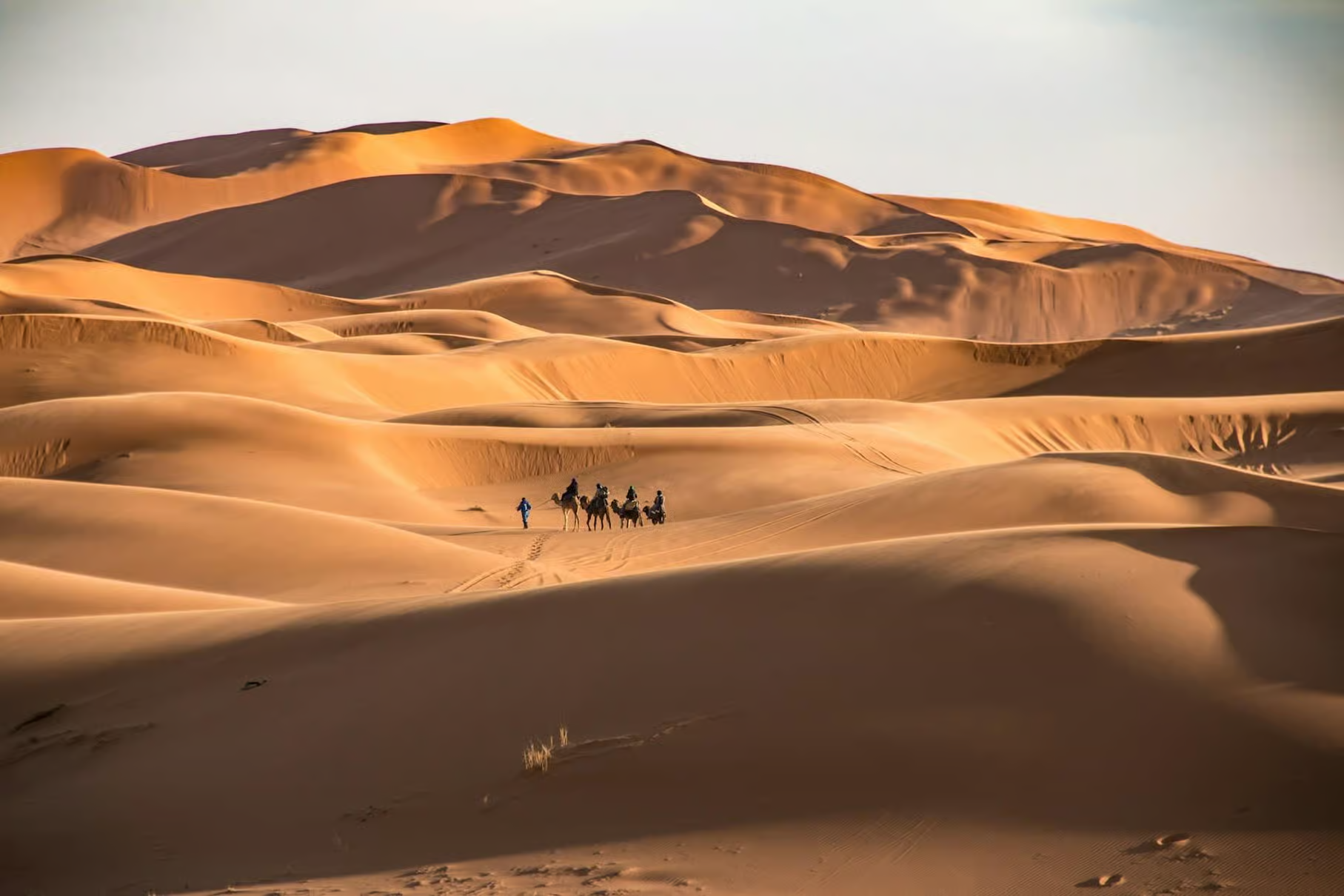
From there, the landscape gradually changes again, palm groves and river valleys giving way to flatter, more arid terrain as the route heads toward Merzouga and the edge of the Sahara. By late afternoon, the golden dunes of Erg Chebbi come into view, and this is where the desert portion of the tour truly begins.
Camels are waiting at the edge of the dunes for the ride out to the desert camp, timed so that the sunset happens while you are still on the move, the sand shifting color as the sun drops toward the horizon. Once at camp, dinner is served along with traditional Berber and Amazigh music, and the night is spent under a sky with far less light pollution than almost anywhere else on the trip.
Day 3: Merzouga to Agadir
The third day starts early, with most travelers waking before dawn to watch the sunrise over the dunes before heading back to meet the vehicle after breakfast. From Merzouga, the route turns west, passing through the Draa Valley, one of Morocco’s longest palm oases, before continuing through the Taznakht and Taliouine region, an area known locally for saffron cultivation and traditional Berber carpet weaving.
The final stretch of the drive brings the landscape from arid plains back toward greener, more coastal terrain as the route approaches Agadir, where the tour concludes. It is a long final day of driving, but broken up by changing scenery for most of the way rather than one uniform stretch of highway.
What You’ll Experience on the Marrakech to Agadir Desert Tour
Beyond the day-by-day stops, this route is really built around a handful of experiences that define the trip as a whole. The High Atlas crossing gives a real sense of scale to Morocco’s mountains, something photos rarely capture properly. The Dades Valley and Todra Gorge offer two very different kinds of dramatic landscape within a single day. Merzouga and the Erg Chebbi dunes are the centerpiece, camel trekking at sunset, a night in a desert camp, and the kind of star-filled sky that is genuinely hard to find outside remote desert locations. Throughout the trip, the hospitality shown by local Berber and Amazigh communities along the route is often something travelers mention as much as the scenery itself.
Marrakech to Agadir Through the Sahara vs Direct Travel
A direct trip from Marrakech to Agadir is exactly that, transportation from one city to another, covering the distance as efficiently as possible along the coastal or more direct inland route. It works well if your priority is simply reaching Agadir, with no interest in stopping along the way.
The 3-day desert route is a different kind of trip entirely. It trades speed for experience, adding the High Atlas Mountains, the Dades Valley, Todra Gorge, and a full night in the Sahara to what would otherwise be a single day of driving. If you are looking for a more personalized way to experience the Sahara, our 3-Day Private Marrakech to Agadir Desert Tour combines private transportation with a desert camp experience before continuing on to Agadir, rather than treating the desert as a separate trip you would need to plan on your own. If your schedule is tighter, a shorter option like one of our Marrakech Day Trips can still offer a taste of the desert without the multi-day commitment, though it won’t include an overnight stay in Merzouga itself.
What Is the Merzouga Desert Camp Experience Like?
For most travelers, this is the part of the trip they remember most clearly. After arriving at the edge of the Erg Chebbi dunes, the camel trek out to camp is timed around sunset, giving riders a slow, quiet approach into the desert as the light changes. Camp itself typically means a traditional Moroccan dinner, followed by live Berber drumming and music around a fire.
Night time in the desert brings a noticeable drop in temperature, even after a warm day, and a sky with far less interference from artificial light than almost anywhere in Marrakech or Agadir. Mornings start early for those who want to catch the sunrise from the dunes before breakfast is served back at camp and the group prepares to continue the journey. For a broader look at what to expect from desert stays in this region generally, our Merzouga Desert Guide goes into more detail on the camp experience and the surrounding area.
What Should You Pack for a 3-Day Marrakech to Agadir Desert Tour?
Packing for this trip means preparing for two very different climates within the same few days, cool mountain mornings and warm, dry desert afternoons that turn cold again at night. A few essentials worth including:
- Comfortable, closed shoes for walking on sand and uneven ground
- Lightweight, breathable clothing for daytime heat
- At least one warm layer for desert nights, temperatures drop significantly after sunset
- Sunglasses and a hat for extended time outdoors
- Sunscreen, reapplied throughout the day
- Personal toiletries and any regular medication
- A camera or phone with enough storage, this is not a trip where you’ll want to run out of space
- A small overnight bag, since larger luggage typically stays with the main vehicle rather than travelling by camel
Our full What to Pack for a Morocco Desert Tour guide covers this in more depth if you want a complete checklist before you go.
Best Time to Take a Marrakech to Agadir Desert Tour
Spring and autumn tend to offer the most comfortable conditions for this route, mild temperatures in the mountains and warm but manageable heat in the desert during the day. Summer brings genuinely high daytime temperatures in the Sahara, which some travelers handle well and others find difficult, though desert nights remain cooler even in the hottest months. Winter days in the desert are usually pleasant, but nighttime temperatures at the camp can drop close to freezing, so a proper warm layer matters more in this season than any other. There is no single “wrong” time to do this trip, but knowing what to expect from the season you’re traveling in helps you pack and plan appropriately.
Private vs Shared Marrakech to Agadir Desert Tour
Both private and shared versions of this route exist, and the choice mostly comes down to flexibility versus cost. A private tour means your own vehicle and driver for the full three days, with the ability to adjust stops, pacing, and timing around your group specifically, useful for families traveling with children, couples wanting a slower pace at certain stops, or groups of friends who would rather not share the vehicle with strangers for three days of driving.
A shared tour follows a similar route at a lower price point, traveling alongside other travelers on a fixed schedule. This works well for solo travelers or anyone prioritizing budget over flexibility. Neither option is inherently better, it depends on what matters more for your specific trip. For more on how we structure our private departures generally, see our Private Morocco Tours page.
Is 3 Days Enough for Marrakech to Agadir Through the Sahara?
Honestly, yes, for what this specific route is designed to do. Three days is enough time to properly cross the Atlas, spend a real night in the desert with a camel trek and camp experience, and continue on to Agadir without doubling back to Marrakech. What it is not is a relaxed, low-mileage trip, this route involves significant driving time across all three days, particularly on day three. If your priority is spending multiple nights in the desert or exploring the Dades and Todra region in more depth, a longer itinerary would allow for that. But for travelers who want a genuine Sahara experience woven into their journey toward Agadir rather than a separate side trip, three days accomplishes that well.
Ready to see this route for yourself? 3-Day Private Marrakech to Agadir Desert Tour and experience the Atlas Mountains, the Sahara, and the road to Agadir at a pace that’s built around your trip, not a fixed group schedule.
Frequently asked questions
Can I travel from Marrakech to Agadir through the Sahara in 3 days?
Yes, this route crosses the High Atlas, stops overnight near the Dades Valley, spends a night in a Merzouga desert camp, and continues on to Agadir on the third day.
Is the Marrakech to Agadir desert tour private?
Both private and shared versions are available. A private tour includes a dedicated vehicle and driver for your group only, with more flexibility over pacing and stops.
Does the tour include Merzouga?
Yes, Merzouga and the Erg Chebbi dunes are the centerpiece of day two, including the camel trek, sunset, and overnight desert camp.
Is camel trekking included?
Yes, the camel trek to and from the desert camp in Merzouga is included as part of the standard itinerary.
Where do we sleep during the desert tour?
The first night is spent in accommodation near the Dades Valley, and the second night is spent in a desert camp near Merzouga.
Is the Marrakech to Agadir desert tour suitable for families?
Yes, particularly the private version, since pacing and stops can be adjusted to suit children or different comfort levels within the group.
What should I pack?
Layered clothing for temperature changes between day and night, comfortable closed shoes, sun protection, and a small overnight bag for the desert camp portion.
What is the best time for this tour?
Spring and autumn generally offer the most comfortable conditions, though the tour runs throughout the year, with each season bringing different temperature considerations.
Is 3 days enough?
Yes, for a genuine Sahara experience combined with onward travel to Agadir. Travelers wanting more time in the desert region itself may prefer a longer itinerary.
Can the itinerary be customized?
On the private version, stops, pacing, and timing can generally be adjusted to fit your group's preferences and schedule.