Lieux à voir et choses à faire Article
Marrakech to Fes in 3 Days: The Full Sahara Route Explained
MApar marrakeshexpresstour 5 min de lecture
Planning the 3-day Marrakech to Fes desert route? Here's the real day-by-day breakdown, driving times, where you sleep, and whether 3 days is actually enough.
What this route actually involves
Avant le détail jour par jour, la version honnête : ce n’est pas une route panoramique avec quelques arrêts. C’est environ 8 à 10 heures de route sur les deux journées les plus longues, pour près de 1 100 km au total une fois ajoutés les détours par Aït Benhaddou, les gorges du Todra et le campement du désert — presque le triple de la distance de l’autoroute directe entre les deux villes. Si cela vous paraît trop, un transfert direct plus court ou une version de 4 jours avec une nuit supplémentaire méritent d’être demandés. Si l’idée de traverser le Sahara, le Haut Atlas et le Moyen Atlas en un seul voyage vaut ces heures de route, voici exactement à quoi ressemblent ces trois jours.
Day 1: Marrakech to Dades Valley (via Aït Benhaddou)
Departure from Marrakech is typically early morning, since the Tizi n’Tichka pass — the day’s first major landmark at roughly 2,260m elevation — is best crossed before midday traffic and before afternoon cloud can obscure the views. The pass itself takes around 2.5-3 hours from Marrakech with photo stops.
Aït Benhaddou follows about 30-45 minutes after descending from the pass — a UNESCO-listed ksar of earthen kasbahs that’s featured in numerous film and TV productions. Budget an hour here to actually walk through the settlement rather than just photograph it from the roadside parking area; the mud-brick detail only really shows up up close.
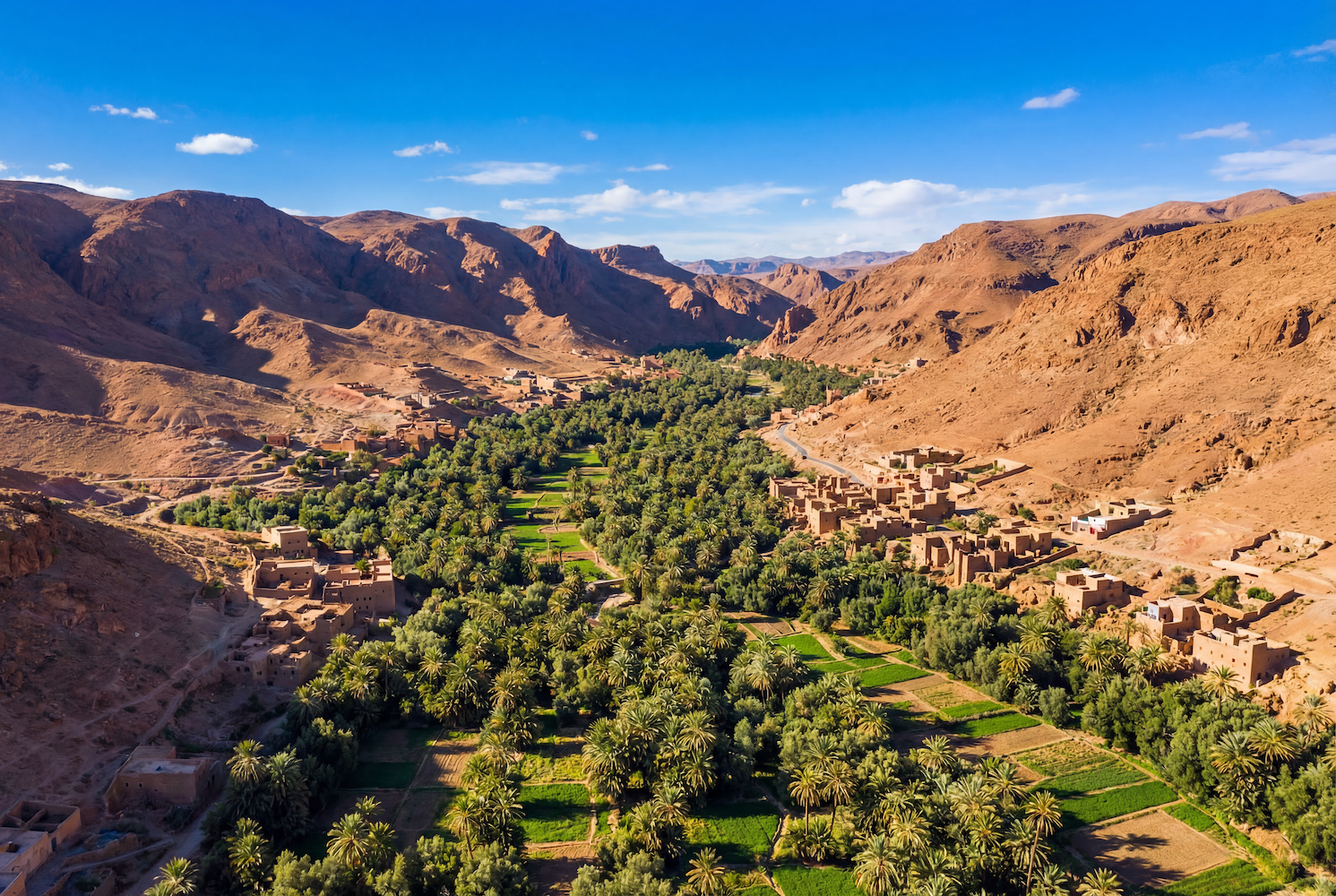
From Aït Benhaddou, the route continues through Ouarzazate — Morocco’s film-industry hub, worth a brief stop if there’s time — and on toward Dades Valley, arriving by early evening. Total driving time for Day 1, including stops: roughly 7-8 hours.
Day 2: Dades Valley to Merzouga (via Todra Gorge)
Les gorges du Todra se trouvent à environ 1h30 à 2 h du Dadès et méritent une arrivée matinale, avant que les autocars ne remplissent l’étroit fond du canyon. Les parois calcaires s’élèvent jusqu’à 300 mètres par endroits tandis que les gorges se resserrent à une dizaine de mètres au plus étroit — une courte marche au fond du canyon (30 à 45 minutes couvrent la section spectaculaire) mérite d’être faite à pied plutôt que depuis le véhicule.
From Todra, it’s roughly 3.5-4 hours on to Merzouga, with the landscape drying out steadily as the Sahara approaches. Arrival is usually timed for mid-to-late afternoon, leaving time to transfer into the desert camp — by 4×4 or camel — before sunset.
The overnight camp near Erg Chebbi’s dunes (some over 150m tall) is the trip’s centerpiece for most travelers: communal dinner, often live music around a fire, and a night sky with essentially no light pollution. Worth setting an alarm for sunrise over the dunes before breakfast.
Day 3: Merzouga to Fes (via Ifrane)
This is the longest single driving day of the three — roughly 8-9 hours covering the desert-to-forest transition through the Middle Atlas. The landscape shift is the fastest of the whole trip: dunes in the morning, cedar forest with Barbary macaques visible roadside by midday, and Ifrane’s alpine-style architecture (at around 1,650m elevation, noticeably cooler than everywhere else on the route) by mid-afternoon.
A 30-45 minute stop in Ifrane makes a good final break before the last stretch into Fes, typically arriving by early evening in time to settle into the medina before dinner.
Where you actually sleep each night
- Night 1: a guesthouse or kasbah-style property in or around Dades Valley
- Night 2: a desert camp near Merzouga, typically private tents with proper beds and en-suite facilities
- Night 3 onward: your own accommodation in Fes, since the tour itself ends on arrival
Is 3 days actually enough?
Pour les voyageurs qui manquent de temps, oui — trois jours couvrent tout l’itinéraire sans sauter aucun des quatre grands sites (Aït Benhaddou, les gorges du Todra, le campement du Sahara, Ifrane). La contrepartie, ce sont deux journées de route vraiment longues encadrant une journée plus courte. Si des matinées sans hâte, une plus longue marche au Todra ou davantage de temps à Aït Benhaddou comptent plus pour vous que gagner un jour, une version de 4 jours avec une nuit supplémentaire existe — mieux vaut la demander directement plutôt que de supposer que trois jours sont la seule option.
How this compares to the Fes-to-Marrakech direction
Same stops, same total distance, opposite order — the choice usually comes down to your flight routing rather than which direction is “better.” Starting in Marrakech and ending in Fes means the desert night falls in the middle of the trip rather than near the start; starting in Fes reverses that. If you’re deciding between directions, our Fes to Marrakech version of this route covers the same stops from the other direction.
What to pack
- Comfortable walking shoes for Todra Gorge and Aït Benhaddou
- Layers — temperatures swing more on this route than almost any other in Morocco, from 2,260m mountain passes to desert nights
- A genuinely warm layer for the desert camp overnight
- A small overnight bag packed separately from your main luggage for the desert night
- Sun protection for the open desert stretches on Day 2
The bottom line
This route works if you’d rather spend three days seeing the High Atlas, Aït Benhaddou, Todra Gorge and the Sahara than take a direct transfer between two cities. It’s demanding — real driving hours, not a leisurely sightseeing pace — but it covers more distinct Moroccan landscape than almost any other three-day itinerary available.