Places to see and things to do Article
Fes to Marrakech in 3 Days: Sahara, Merzouga & Todra Gorge Route
MAby marrakeshexpresstour 7 min read
A 3-day private journey from Fes to Marrakech via the Sahara: Ifrane, Merzouga's dunes, Todra Gorge, Dades Valley and Aït Benhaddou. Full route, stops and what to pack.
Introduction
This isn’t a transfer with scenery attached — it’s roughly 550-600km of driving spread across three days, and every few hours the landscape changes completely. Cedar forest gives way to high plateau, plateau gives way to dunes, dunes give way to canyon, canyon gives way to kasbah. Going Fes to Marrakech instead of the reverse direction means starting in the older imperial city and ending in the one built for arrival — the Red City feels like a destination precisely because of everything you crossed to reach it.
Day 1: Fes → Ifrane → Cedar Forests → Midelt → Merzouga
A Morning in Ifrane
About 1.5 hours south of Fes, Ifrane sits at roughly 1,650m elevation, which is why it’s noticeably cooler than Fes year-round and gets genuine snowfall in winter — pitched roofs and stone chalets that look transplanted from the Alps rather than anything typically Moroccan. Worth 30-45 minutes to walk the small town center and get a coffee before the road climbs further into the Middle Atlas.
Through the Cedar Forests
The Azrou cedar forest is one of the last strongholds of Barbary macaques in the wild — troops are regularly visible right along the roadside, especially in the stretch between Azrou and Ifrane, though it’s worth remembering they’re wild animals and shouldn’t be fed despite how used to cars they seem. Some of the cedars here are genuinely old growth, well over 200 years, and the elevation (up to 2,000m in places) means the temperature can be 10-15°C cooler than it was in Fes that same morning.
Midelt and the Road Toward the Desert
Midelt sits roughly at the halfway point of Day 1’s drive and makes a natural lunch stop before the road descends into the Ziz Valley. From here the transformation genuinely accelerates — within an hour or two of leaving Midelt, the green mountain terrain is gone and the palm-lined Ziz Valley opens up, often with the first real desert light of the trip.
Arriving in Merzouga
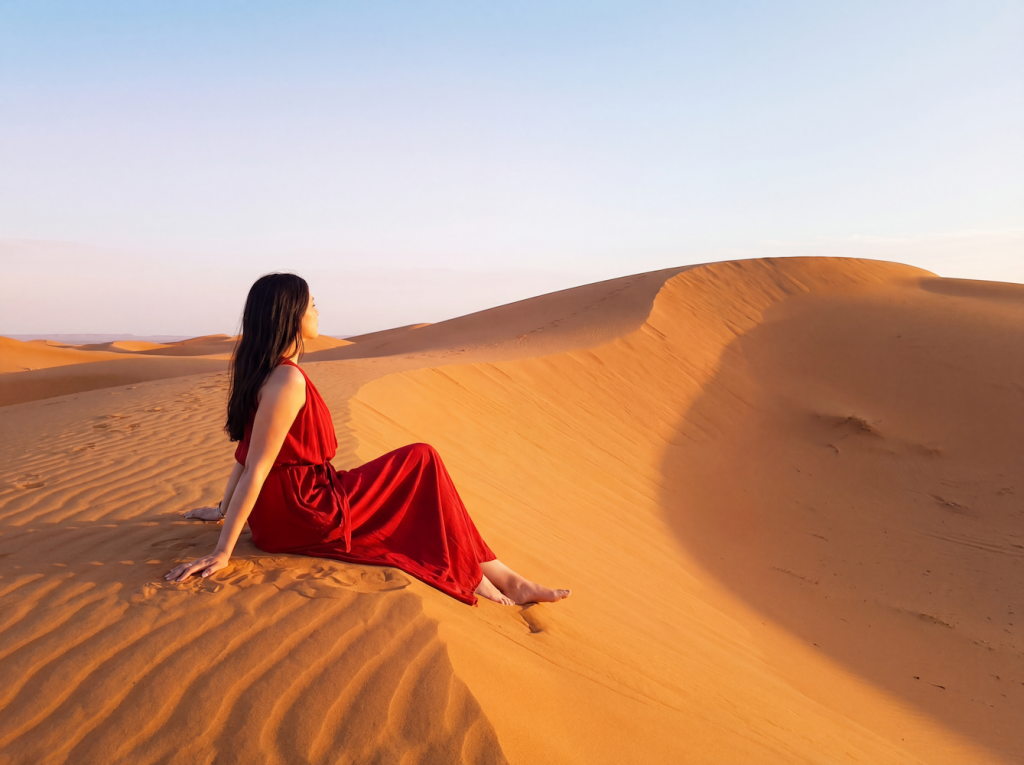
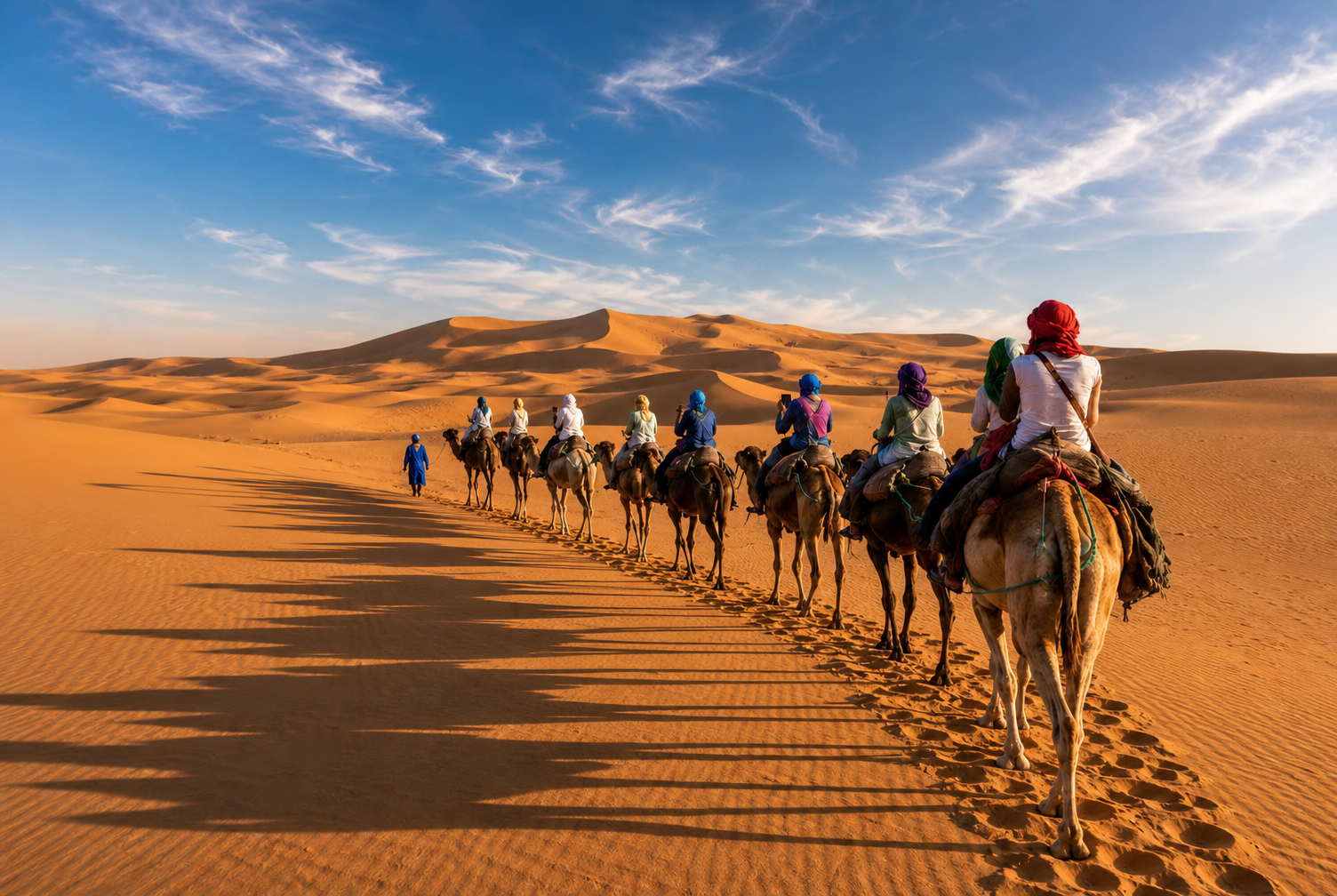
By late afternoon (typically 4-6pm depending on the morning’s pace), Erg Chebbi’s dunes appear on the horizon — some reaching over 150 meters, among the tallest in Morocco. This is usually where 4×4 or camel transfers into the desert camp begin, timed so the transfer itself lands close to sunset.
Sunset Over the Sahara
The color shift happens fast, usually within 20-30 minutes — pale gold at first light contact, then orange, then a deep red as the sun drops below the dune line. Climbing even a modest dune near camp (not necessarily the tallest one) is usually enough for an unobstructed view in every direction.
A Night in a Desert Camp
Desert camps here typically combine private tents with proper beds and en-suite facilities alongside traditional touches — communal dinner, sometimes live drumming around a fire afterward. Worth setting an alarm for sunrise: the temperature swing overnight in the Sahara can be significant even outside deep winter, so a warm layer for the pre-dawn walk out is worth having ready the night before rather than packed away.
Day 2: Merzouga → Rissani → Todra Gorge → Dades Valley
Discover Todra Gorge
The drive from Merzouga to Todra Gorge via Rissani takes roughly 3-3.5 hours. The gorge’s limestone walls rise up to 300 meters in places while the canyon floor narrows to as little as 10 meters at its tightest point — a genuinely dramatic contrast after a full day of open desert driving. A short walk along the canyon floor (30-45 minutes round trip covers the most dramatic section) is worth the stop even without technical climbing gear, since the walls are visible from the road itself.
Continue Through Dades Valley
From Todra, the route continues roughly 1.5-2 hours to Dades Valley, where red rock formations, palm groves and terraced fields replace the gorge’s sheer walls. The valley’s switchback road — often called the “Road of a Thousand Kasbahs” — is one of the most photographed stretches in southern Morocco, and the light in late afternoon brings out the red rock especially well.
A Peaceful Night in the Valley
The second night is usually spent at a guesthouse or boutique kasbah-style property in or around Dades — a different rhythm from the desert camp the night before, with mountains and terraced valley visible from the room rather than open dunes. A good night to have an early dinner, since Day 3 is the longest driving day of the three.
Day 3: Dades Valley → Ouarzazate → Aït Benhaddou → High Atlas → Marrakech
Aït Benhaddou: A Moroccan Architectural Treasure
About 2-2.5 hours from Dades via Ouarzazate, Aït Benhaddou is a UNESCO World Heritage ksar (fortified village) of earthen kasbahs along the former caravan route between the Sahara and Marrakech, and has appeared as a filming location in numerous international productions. Walking through the ksar itself, rather than just photographing it from the road across the river, is worth the extra 30-45 minutes — the narrow passages and towers are far more striking up close.
Crossing the High Atlas Mountains
The Tizi n’Tichka pass tops out at roughly 2,260 meters, making it one of the highest paved mountain roads in North Africa. The drive from Aït Benhaddou over the pass to Marrakech takes about 3-3.5 hours depending on stops, with switchback after switchback offering some of the trip’s best final views back over the valleys just crossed. Worth noting for anyone prone to motion sickness — this is the most winding stretch of the entire three-day route.
Arriving in Marrakech
Descending from the pass, the landscape flattens back into palm groves and the red earth Marrakech is known for, with the city’s outskirts typically reached by late afternoon or early evening on Day 3. After three days of changing terrain, arriving into Marrakech’s noise and color feels less like reaching a random endpoint and more like the trip’s actual conclusion.
Why Choose the Fes to Marrakech Route?
The core advantage is that you need to get between these two cities anyway — this route turns that logistics problem into the single richest stretch of the whole Morocco itinerary, covering the Middle Atlas, the Sahara, Todra Gorge, Dades Valley and Aït Benhaddou in one continuous journey rather than as separate day trips from a single base.
Is Three Days Enough?
Three days works for travelers on a tighter schedule, but it means two genuinely long driving days (roughly 6-8 hours of road time each, including stops) bookending one shorter one. Travelers who’d rather have slower mornings, a longer walk at Todra Gorge, or time to properly explore Aït Benhaddou without watching the clock should look at extending to four days — ask about our longer Fes-Marrakech itineraries if that sounds like a better fit than the compressed three-day version.
What to Pack for the Journey
Given the elevation swings — from near sea level in the Ziz Valley up to 2,260m at Tizi n’Tichka, and cool nights even in the desert — layering matters more on this route than almost any other in Morocco:
- Comfortable walking shoes for Todra Gorge and Aït Benhaddou
- Light layers for daytime temperature swings between valley and mountain
- A genuinely warm layer for the desert camp overnight — colder than most first-timers expect
- Sunglasses and sun protection for the open desert stretches
- A small overnight bag packed separately, since the desert camp doesn’t need your full luggage
- Camera or smartphone with spare storage — this route produces more photo stops than almost any other
- Reusable water bottle, refilled at each stop rather than relying on single-use bottles
The Real Luxury Is the Journey
Treating this as a straight transfer misses the point. Forest becomes mountain. Mountain becomes valley. Valley becomes desert. Desert becomes canyon. Canyon becomes kasbah. Few routes anywhere in Morocco pack that many distinct landscapes into three days without backtracking.
Final Thoughts
Fes and Marrakech are the two names everyone books around, but the roughly 550-600km between them holds cedar forests, the Sahara’s dunes, Todra’s limestone walls, Dades’ red rock and Aït Benhaddou’s earthen towers. You don’t simply travel from Fes to Marrakech. You cross Morocco.